Start with the service you need below. Each section tells you who it's for, what documents you'll need and how long it takes — then reach us on WhatsApp to begin.
GST Registration
Tax & Compliance
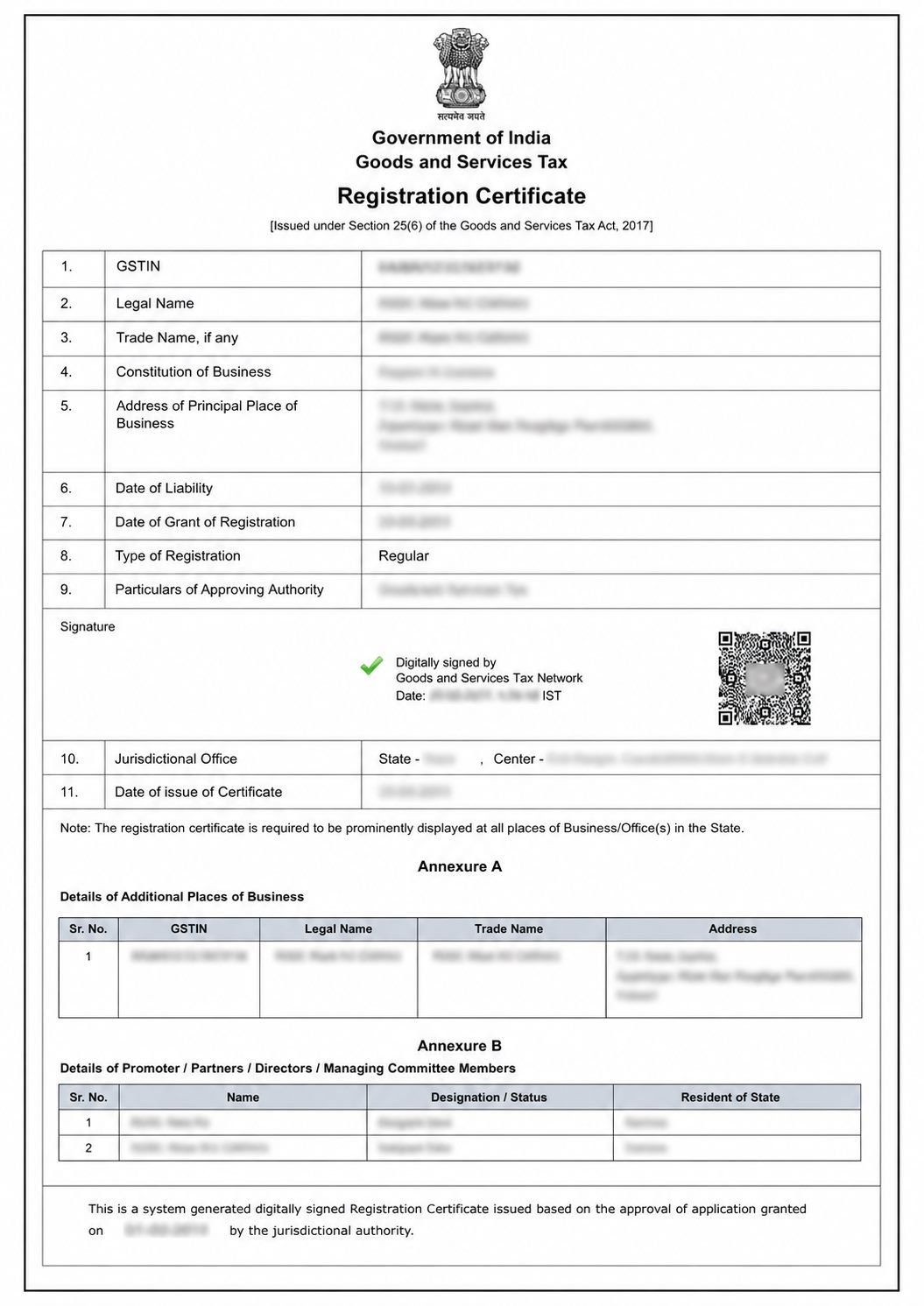
GST registration gives your business a GSTIN — a legal identity under India's Goods and Services Tax system. It is mandatory once your turnover crosses the threshold (₹40 lakh for goods, ₹20 lakh for services in most states), and from day one if you sell through e-commerce platforms, make inter-state supplies, or import/export. We prepare the application, upload documents on the GST portal, respond to any officer queries and stay on it until your GSTIN is issued.
The Registration Certificate you receive on approval — digitally signed by GSTN
Documents typically required
PAN & Aadhaar of proprietor / partners / directors
Passport-size photo
Business address proof (electricity bill / rent agreement / NOC)
Bank details (cancelled cheque / statement)
Certificate of incorporation / partnership deed (if applicable)
Good to know
Typical timeline: 3–7 working days
Government fee: nil — you pay only professional charges
Includes guidance on composition vs regular scheme
Every GST-registered business must file returns — even in months with zero sales. We take over the entire cycle: reconciling your sales and purchase data, preparing GSTR-1 and GSTR-3B (monthly or under QRMP), claiming eligible input tax credit and filing before the due date, with a confirmation sent to you on WhatsApp after every filing. Annual returns (GSTR-9) and notice replies are handled too.
What we need from you each period
Sales invoices / e-commerce sales reports
Purchase invoices for input credit
GST portal access (we set this up securely with you)
Good to know
Monthly, quarterly (QRMP) and annual plans available
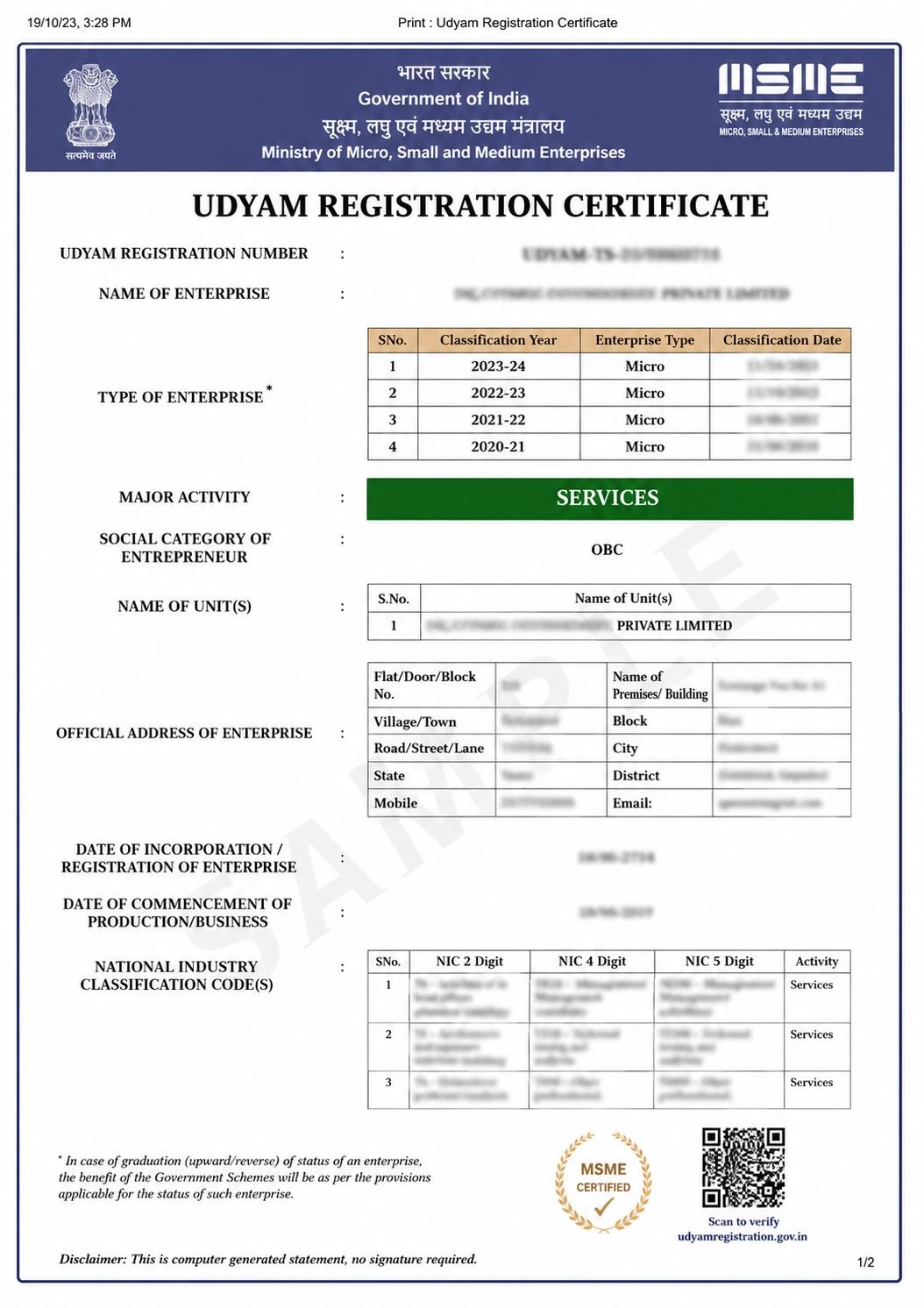
Udyam registration officially recognises your business as a Micro, Small or Medium Enterprise. It unlocks collateral-free loans under priority-sector lending, interest subsidies, protection against delayed payments from buyers, concessions in government tenders and various state-level incentives. Registration is fully online against your Aadhaar and PAN, and the certificate is valid for a lifetime — we ensure your classification and NIC activity codes are entered correctly the first time.
The Udyam Registration Certificate you receive — valid for a lifetime
Documents typically required
Aadhaar of proprietor / authorised signatory
PAN of the business / individual
GSTIN (where applicable)
Basic business details (activity, investment, turnover)
Good to know
Typical timeline: 1–2 working days
Lifetime validity — no renewal needed
Often required alongside GeM and tender registrations
The Registration-cum-Membership Certificate (RCMC) is issued by Export Promotion Councils and commodity boards, and is required to claim benefits under India's Foreign Trade Policy — including duty-remission schemes and export incentives. Choosing the right council for your product is the tricky part; we identify the correct EPC for your HS codes, prepare the membership application on the DGFT e-RCMC portal and follow it through to issuance.
Documents typically required
IEC certificate
PAN & GST certificate
List of export products / HS codes
DSC of the authorised signatory
Good to know
Typical timeline: 5–10 working days
We advise which EPC / board fits your products
Required for FTP benefits and many export incentives
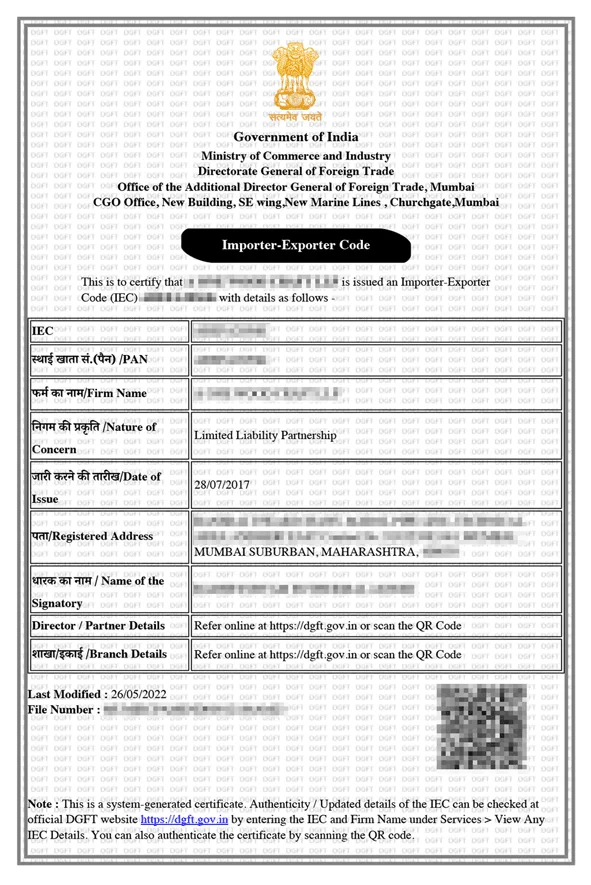
The Import Export Code, issued by DGFT, is the 10-digit licence every Indian business needs before importing or exporting goods or services. Without it, customs clearance and foreign remittances simply don't move. We file your IEC application on the DGFT portal, link it with your PAN and bank details correctly, and also handle annual IEC updation — which is mandatory even when nothing has changed, or the code gets deactivated.
The Importer-Exporter Code certificate you receive from DGFT
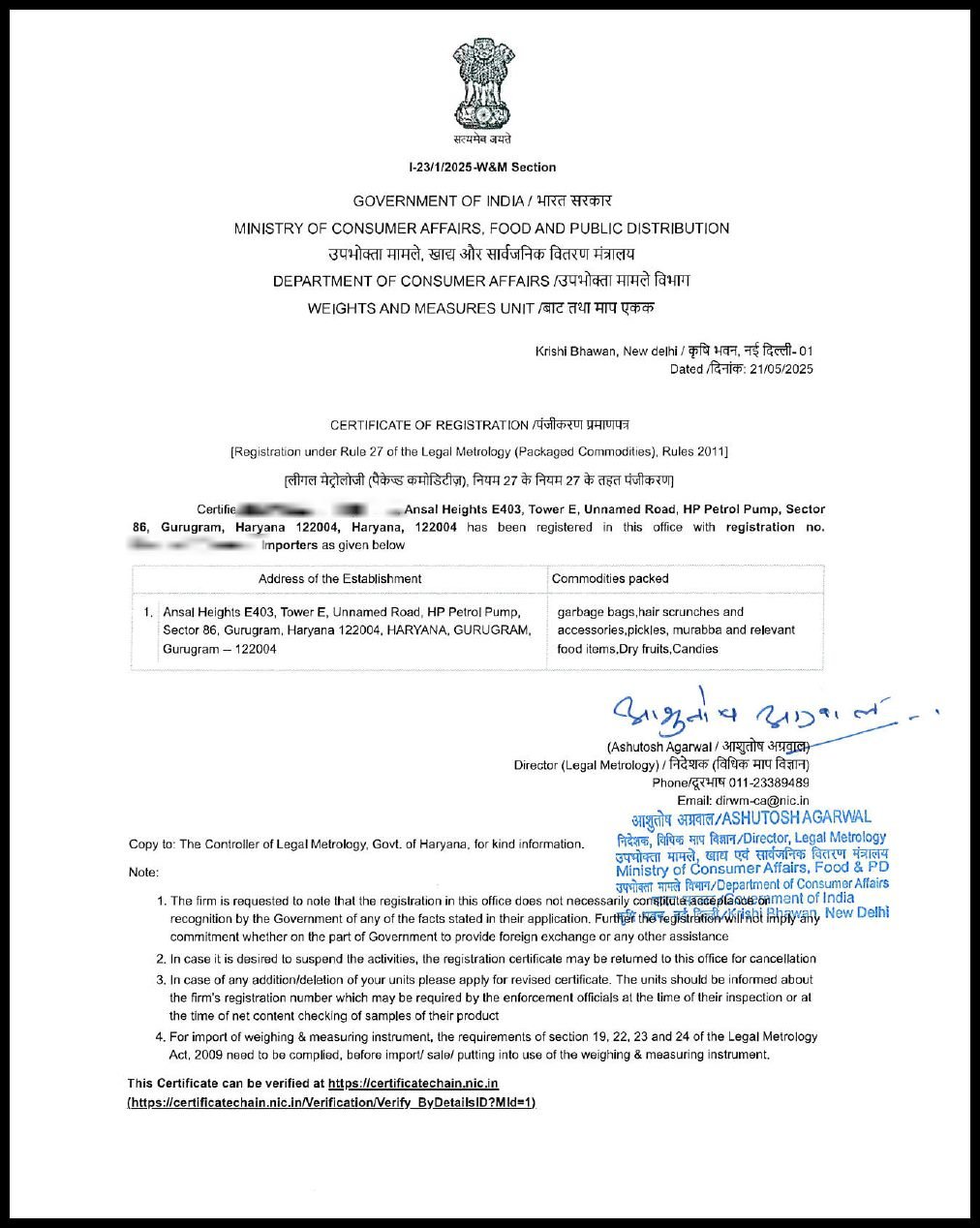
Under the Legal Metrology (Packaged Commodities) Rules, any importer, manufacturer or packer of pre-packaged goods must register with the Legal Metrology department before those goods can be sold in India. Customs increasingly holds shipments of packaged goods that lack an LMPC certificate. We prepare your application with the correct packer/importer declarations and label compliance details, so your consignments clear without holdups.
The LMPC Certificate of Registration you receive on approval
Documents typically required
IEC and GST certificates
PAN & identity proof of applicant
List of packaged commodities / sample labels
Premises address proof
Good to know
Typical timeline: 7–15 working days (state-dependent)
Mandatory for importers of pre-packaged goods
We also review your labels for MRP/declaration compliance
The India–UAE Comprehensive Economic Partnership Agreement lets Indian exporters ship thousands of product lines to the UAE at reduced or zero customs duty — but only with a valid preferential Certificate of Origin for each consignment. We register you on the CoO e-platform, verify that your products meet the rules-of-origin criteria, and process your CEPA certificates shipment after shipment so your UAE buyers actually receive the duty benefit.
Documents typically required
IEC & DSC of authorised signatory
Commercial invoice & packing list
Product details / HS codes & manufacturing process
Costing sheet for rules-of-origin value addition
Good to know
Per-shipment certificates, usually issued in 1–3 days
Duty savings often far exceed the cost of certification
Under the South Asian Free Trade Area agreement, exports from India to SAARC countries — Bangladesh, Sri Lanka, Nepal, Bhutan, Maldives, Pakistan and Afghanistan — can attract significantly lower import duty when accompanied by a SAFTA Certificate of Origin. We handle your registration with the issuing authority, confirm your goods satisfy the origin criteria and obtain the certificates for each export consignment.
Documents typically required
IEC & exporter profile
Invoice, packing list & shipping details
Product origin / manufacturing declaration
Good to know
Certificates typically issued in 1–3 working days
Ideal for regular exporters to Bangladesh, Nepal & Sri Lanka
Combine with RCMC for full export-benefit coverage
Government buyers — from ministries to PSUs and GeM — give purchase preference to products with certified Indian local content under the Public Procurement (Preference to Make in India) Order. We help you compute your local-content percentage, prepare the required self-declarations or certifications, and position your business as a Class-I or Class-II local supplier so you qualify for tenders that are otherwise closed to you.
Documents typically required
Company incorporation & GST documents
Bill of materials / cost break-up of the product
Details of imported vs domestic inputs
CA certificate where the tender demands one
Good to know
Class-I supplier: ≥50% local content; Class-II: ≥20%
Opens purchase preference in government tenders & GeM
A Class-3 Digital Signature Certificate is your legally valid digital identity for signing documents and filings online — company incorporation, income-tax and GST portals, e-tenders, trademark filings and DGFT transactions (which need a special DGFT DSC). We arrange your DSC with paperless Aadhaar-based eKYC and a video verification that takes minutes, and deliver the USB token to your door.
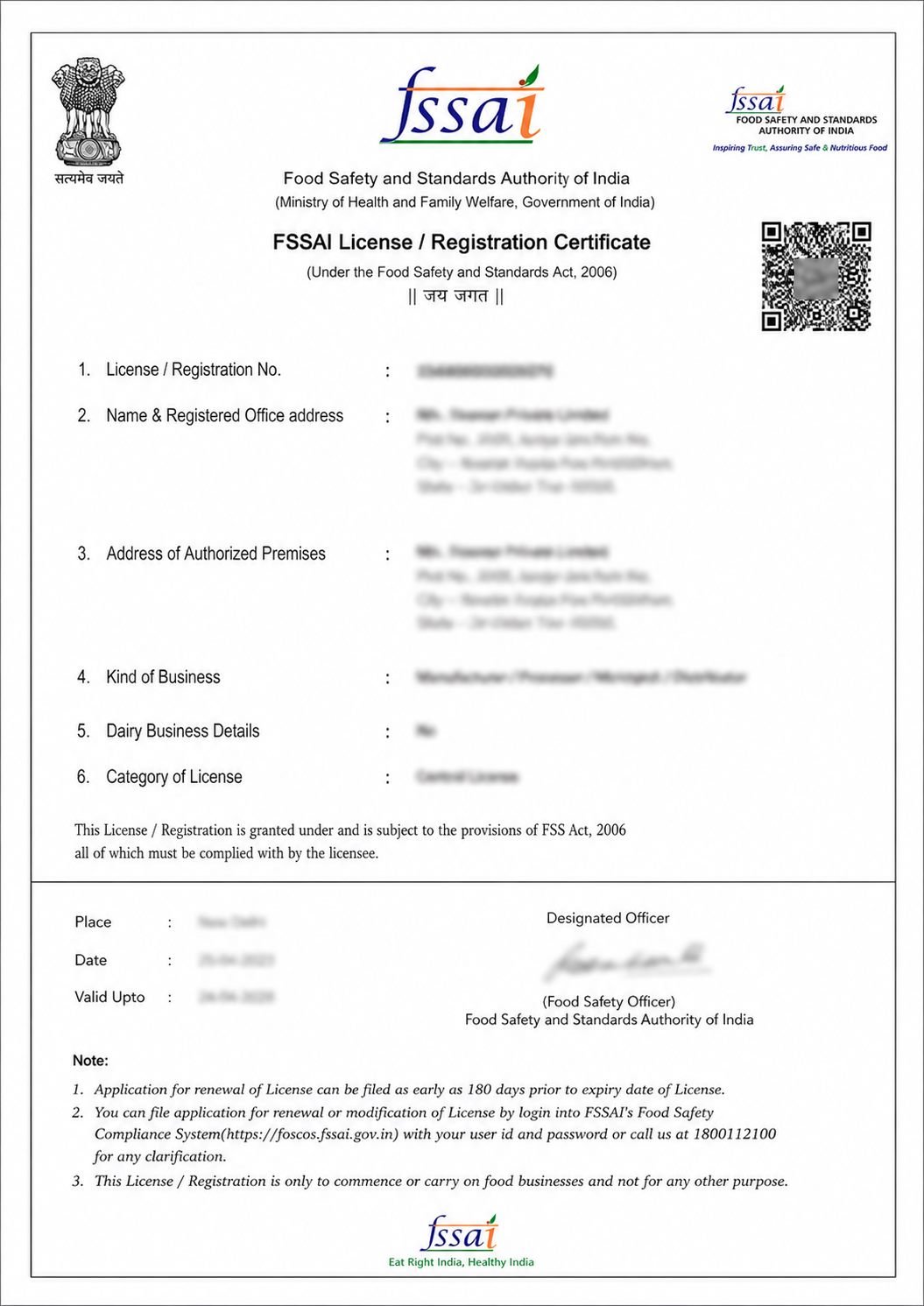
Every food business in India — restaurants, cloud kitchens, home bakers, traders, transporters, importers and manufacturers — must hold an FSSAI registration or licence, and print the 14-digit number on packaging and menus. Which one you need (Basic registration, State licence or Central licence) depends on turnover and activity. We determine the correct category, file on the FoSCoS portal and manage renewals so your licence never lapses.
The FSSAI Licence / Registration Certificate you receive on approval
The Shop & Establishment Act registration (in Delhi and most states) is one of the first licences a new office, shop, or commercial establishment needs — often within 30 days of starting operations. Banks frequently ask for it when opening a current account. We file with the state labour department, ensure your employee details and working-hours declarations are correct, and handle amendments when your address or headcount changes.